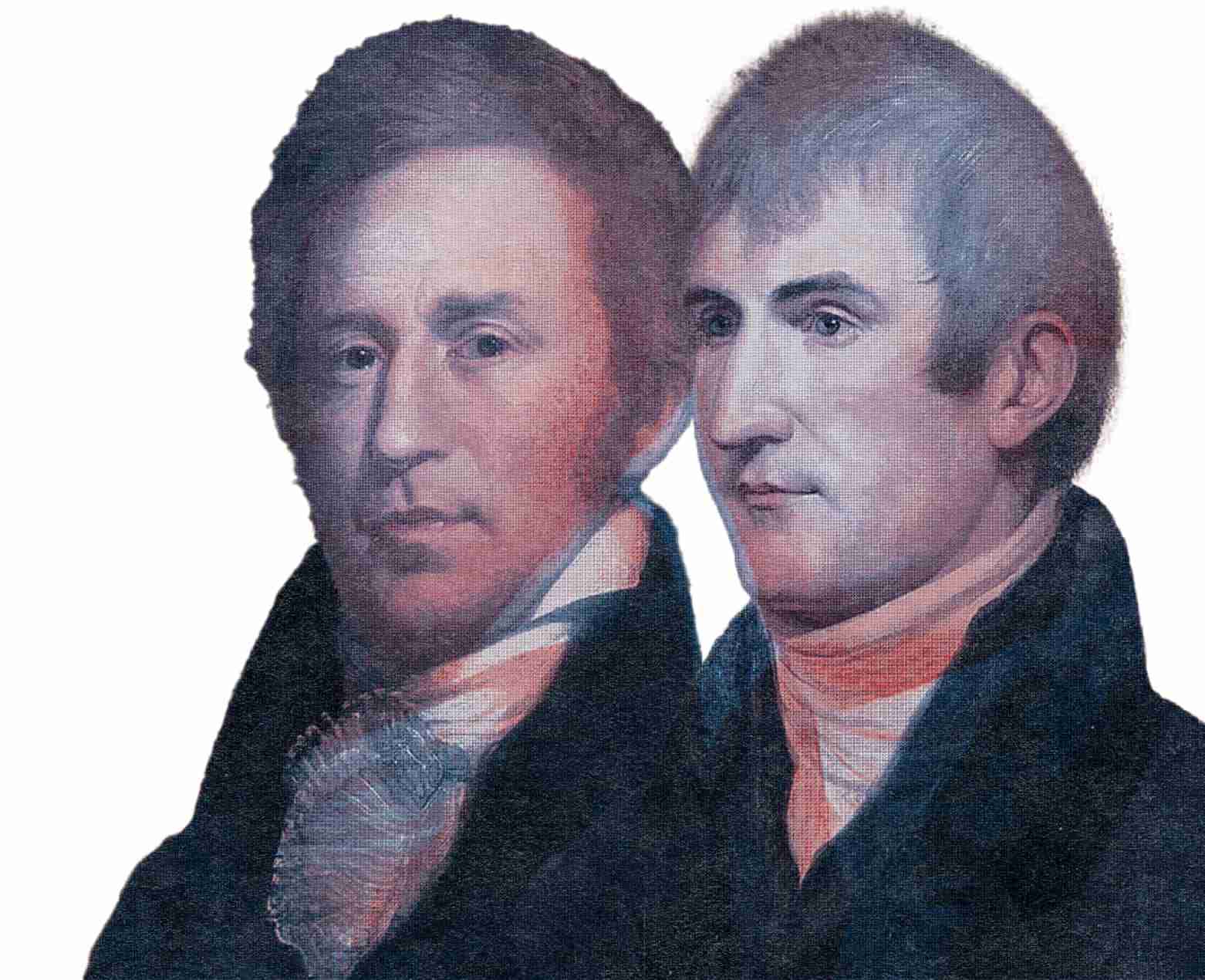
Pacificus (Alexander Hamilton)
[Hamilton’s argument appeared in the Gazette of the United States, published in Philadelphia, on June 29, 1793. All italics are from the original.]
*********
The objections [to President Washington’s Proclamation of Neutrality] fall under four heads:
1. That the proclamation was without authority.
2. That it was contrary to our treaties with France.
3. That it was contrary to the gratitude which is due from this to that country, for the succors afforded to us in our own revolution.
4. That it was out of time and unnecessary.
.........
The inquiry then is, what department of our government is the proper one to make a declaration of neutrality, when the engagements of the nation permit, and its interests require that it should be done?
A correct mind will discern at once, that it can belong neither to the legislature nor judicial department, and of course must belong to the executive.
The legislative department is not the organ of intercourse between the United States and foreign nations. It is charged neither with making nor interpreting treaties. It is therefore not naturally that member of the government, which is to pronounce the existing condition of the nation, with regard to foreign powers, or to admonish the citizens of their obligations and duties in consequence; still less is it charged with enforcing the observance of those obligations and duties.
It is equally obvious, that the act in question is foreign to the judiciary department. The province of that department is to decide litigations in particular cases. It is indeed charged with the interpretation of treaties, but it exercises this function only where contending parties bring before it a specific controversy. It has no concern with pronouncing upon the external political relations of treaties between government and government. This position is too plain to need being insisted upon.
It must then of necessity belong to the executive department to exercise the function in question, when a proper case for it occurs.
It appears to be connected with that department in various capacities—As the organ of intercourse between the nation and foreign nations; as the interpreter of the national treaties, in those cases in which the judiciary is not competent, that is, between government and government; as the power which is charged with the execution of the laws, of which treaties form a part; as that which is charged with the command and disposition of the public force....
The second article of the Constitution of the United States, section first, establishes this general proposition, that "the EXECUTIVE POWER shall be vested in a President of the United States of America."
....
The general doctrine of our Constitution...is that the executive power of the nation is vested in the President; subject only to the exceptions and qualifications, which are expressed in the instrument.
Two of [the exceptions are]...the participation of the senate in the appointment of officers, and in the making of treaties. A third remains to be mentioned; the right of the legislature "to declare war, and grant letters of marque and reprisal." ...
If on the one hand, the legislature have a right to declare war, it is on the other, the duty of the executive to preserve peace, till the declaration is made; and in fulfilling this duty, it must necessarily possess a right of judging what is the nature of the obligations which the treaties of the country impose on the government; and when it has concluded that there is nothing in them inconsistent with neutrality, it becomes both its province and its duty to enforce the laws incident to that state of the nation. The executive is charged with the execution of all laws, the law of nations, as well as the municipal law, by which the former are recognized and adopted. It is consequently bound, by executing faithfully the laws of neutrality, when the country is in a neutral position, to avoid giving cause of war to foreign powers....
The right of the executive to receive ambassadors and other public ministers, may serve to illustrate the relative duties of the executive and legislative departments. This right includes that of judging, in the case of a revolution of government in a foreign country, whether the new rulers are competent organs of the national will, and ought to be recognized, or not; which, where a treaty antecedently exists between the United States and such nation, involves the power of continuing or suspending its operation. For until the new government is acknowledged, the treaties between the nations, so far at least as regards public rights, are of course suspended.
This power of determining virtually upon the operation of national treaties, as a consequence of the power to receive public ministers, is an important instance of the right of the executive, to decide upon the obligations of the country with regard to foreign nations. To apply it to the case of France, if there had been a treaty of alliance, offensive and defensive between the United States and that country, the unqualified acknowledgment of the new government would have put the United States in a condition to become an associate in the war with France, and would have laid the legislature under an obligation, if required, and there was otherwise no valid excuse, of exercising its power of declaring war.
This serves as an example of the right of the executive, in certain cases, to determine the condition of the nation, though it may, in its consequences, affect the exercise of the power of the legislature to declare war. Nevertheless, the executive cannot thereby control the exercise of that power. The legislature is still free to perform its duties, according to its own sense of them; though the executive, in the exercise of its constitutional powers, may establish an antecedent state of things, which ought to weigh in the legislative decision.
The division of the executive power in the Constitution, creates a concurrent authority in the cases to which it relates.
Hence, in the instance stated, treaties can only be made by the president and senate jointly; but their activity may be continued or suspended by the President alone....
It deserves to be remarked, that as the participation of the senate in the making of treaties, and the power of the legislature to declare war, are exceptions out of the general "executive power" vested in the President, they are to be construed strictly, and ought to be extended no further than is essential to their execution.
While, therefore, the legislature can alone declare war, can alone actually transfer the nation from a state of peace to a state of hostility, it belongs to the "executive power" to do whatever else the law of nations, cooperating with the treaties of the country, enjoin in the intercourse of the United States with foreign powers.
In this distribution of authority, the wisdom of our Constitution is manifested. It is the province and duty of the executive to preserve to the nation the blessings of peace. The legislature alone can interrupt them by placing the nation in a state of war.
....
Helvidius (James Madison)
[Madison’s rebuttal to Hamilton appeared in a series of articles that appeared in the Gazette of the United States between August 24 and September 18, 1793. All italics are from the original.]
*******
No. 1
....
Let us examine [the doctrine being propounded by Pacificus]:
In the general distribution of powers, we find that of declaring war expressly vested in the congress, where every other legislative power is declared to be vested; and without any other qualifications than what is common to every other legislative act. The constitutional idea of this power would seem then clearly to be, that it is of a legislative and not an executive nature.
This conclusion becomes irresistible, when it is recollected, that the constitution cannot be supposed to have placed either any power legislative in its nature, entirely among executive powers, or any power executive in its nature, entirely among legislative powers, without charging the constitution, with that kind of intermixture and consolidation of different powers, which would violate a fundamental principle in the organization of free governments. If it were not unnecessary to enlarge on this topic here, it could be shown, that the constitution was originally vindicated, and has been constantly expounded, with a disavowal of any such intermixture.
The power of treaties is vested jointly in the president and in the senate, which is a branch of the legislature. From this arrangement merely, there can be no inference that would necessarily exclude the power from the executive class: since the senate is joined with the president in another power, that of appointing to offices, which, as far as relate to executive offices at least, is considered as of an executive nature. Yet on the other hand, there are sufficient indications that the power of treaties is regarded by the constitution as materially different from mere executive power, and as having more affinity to the legislative than to the executive character.
...That treaties, when formed according to the constitutional mode, are confessedly to have force and operation of laws, and are to be a rule for the courts in controversies between man and man, as much as any other laws.
They are even emphatically declared by the constitution to be "the supreme law of the land."
So far the argument from the constitution is precisely in opposition to the doctrine. As little will be gained in its favour from a comparison of the two powers, with those particularly vested in the president alone.
As there are but few, it will be most satisfactory to review them one by one.
"The president shall be commander in chief of the army and navy of the United States, and of the militia when called into the actual service of the United States."
There can be no relation worth examining between this power and the general power of making treaties. And instead of being analogous to the power of declaring war, it affords a striking illustration of the incompatibility of the two powers in the same hands. Those who are to conduct a war cannot in the nature of things, be proper or safe judges, whether a war ought to be commenced, continued, or concluded. They are barred from the latter functions by a great principle in free government, analogous to that which separates the sword from the purse, or the power of executing from the power of enacting laws....
Thus it appears that by whatever standard we try this doctrine, it must be condemned as no less vicious in theory than it would be dangerous in practice. It is countenanced neither by the writers on law; nor by the nature of the powers themselves; nor by any general arrangements, or particular expressions, or plausible analogies, to be found in the constitution.
Whence then can the writer have borrowed it?
There is but one answer to this question.
The power of making treaties and the power of declaring war, are royal prerogatives in the British government, and are accordingly treated as executive prerogatives by British commentators....
No. 2
Leaving however to the leisure of the reader deductions which the author, having omitted, might not choose to own, I proceed to the examination of one, with which that liberty cannot be taken.
"However true it may be, (says he,) that the right of the legislature to declare war includes the right of judging, whether the legislature be under obligations to make war or not, it will follow that the executive is in any case excluded from a similar right of judging in the execution of its own functions."....
A concurrent authority in two independent departments, to perform the same function with respect to the same thing, would be as awkward in practice, as it is unnatural in theory.
If the legislature and executive have both a right to judge of the obligations to make war or not, it must sometimes happen, though not at present, that they will judge differently. The executive may proceed to consider the question today; may determine that the United States are not bound to take part in a war, and, in the execution of its functions, proclaim that declaration to all the world. Tomorrow the legislature may follow in the consideration of the same subject; may determine that the obligations impose war on the United States, and, in the execution of its functions, enter into a constitutional declaration, expressly contradicting the constitutional proclamation.
In what light does this present the constitution to the people who established it? In what light would it present to the world a nation, thus speaking, through two different organs, equally constitutional and authentic, two opposite languages, on the same subject, and under the same existing circumstances?
But it is not with the legislative rights alone that this doctrine interferes. The rights of the judiciary may be equally invaded. For it is clear that if a right declared by the constitution to be legislative, leaves, notwithstanding, a similar right in the executive, whenever a case for exercising it occurs, in the course of its functions; a right declared to be judiciary and vested in that department may, on the same principle, be assumed and exercised by the executive in the course of its functions; and it is evident that occasions and pretexts for the latter interference may be as frequent as for the former. So again the judiciary department may find equal occasions in the execution of its functions, for usurping the authorities of the executive; and the legislature for stepping into the jurisdiction of both. And thus all the power of government, of which a partition is so carefully made among the several branches, would be thrown into absolute hotchpot and exposed to a general scramble....